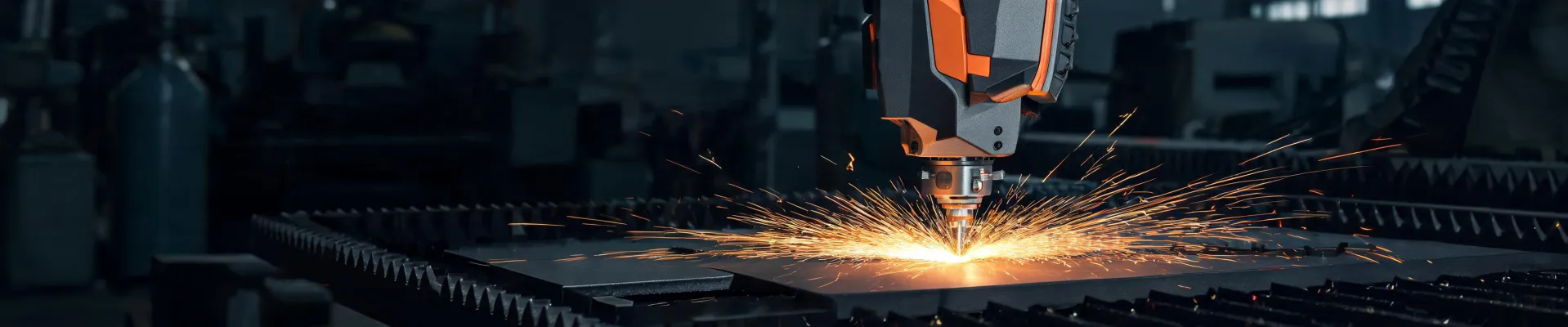
Why Your Laser Cutting Machine Is Your Brand—A Procurement Manager's View
Posted on 2026-08-04 by Elise Marceau
I manage procurement for a 32-person metal fabrication shop. Over the past six years, I've tracked $180,000+ in equipment and consumables spending, negotiated with more than a dozen vendors, and documented every order in our cost tracking system. And I've made every mistake you can make when buying cutting equipment. I've gone with the cheapest quote, skipped the spec review, and approved a rush charge I could've negotiated. (unfortunately)
Here's my unpopular opinion: Your laser machine is your brand. Not your website. Not your logo. The edge quality of the part you hand to a customer is what they remember. When I say "brand," I do not mean a logo or a color palette—I mean the impression your output leaves behind.
I believe most B2B shops are losing money by treating cutting quality as a commodity instead of a brand investment. That's not the kind of thing you usually hear from a procurement guy. But after six years of staring at invoices and cut edges, I'm convinced.
The Classic Mistake I Made as a Novice
In my first year, I made the classic buying error: I chose the lowest quote and skipped the verification. We were outsourcing all cutting back then, and my CEO asked me to "bring the cutting costs down." I compared six vendors, found one 22% cheaper, and signed without visiting their facility or requesting a test cut.
The first order came back with edges that were passable but not clean. Two parts were out of tolerance. In my first year, I made the classic specification error: assumed "standard" meant the same thing to every vendor. Cost me a $600 redo and a painful phone call with a client who had already spotted the defect before we did.
I didn't fully understand the value of detailed specifications until that $3,000 order, to be honest. We had to redo the two parts, push our timeline back by three days, and explain to a customer that "we're fixing it." None of that is in the vendor's price quote.
What did I learn? Not that "cheaper means worse." I learned that cheap without verification is gambling—and you're gambling with your customer's perception of your company.
The Face-Off That Changed My Mindset
Fast-forward to November 2023. We had a rush order from a long-term client: forty parts, tight tolerances, three-day turnaround. Our usual vendor couldn't deliver on time, so I had to decide quickly: hire plasma cutter services at a local shop or blow an important deadline.
I hired the local shop. Plasma cutting is legitimate—don't get me wrong. For thick plate, it's often the best tool. But when the parts arrived and I placed them next to parts from our regular fiber laser vendor, the difference was unmistakable. Same drawing. Same material. Different story.
The plasma cut edges had more dross, a slightly rougher finish, and a subtle taper that you could feel with a fingernail. The fiber laser edges were clean and square. Nobody rejected the plasma parts, but the contrast sat in the back of my mind.
Seeing our rush-order output vs. our standard output over that quarter made me realize: the process is the product. It's not just about "getting it cut." It's about what the cut says about your standards.
That incident triggered a full review of how we source cutting services. We had no formal process for evaluating cut quality. We didn't have a checklist for comparing vendors. The third time we saw inconsistent quality from an outside shop, I finally created a verification system—but I should have done it after the first incident.
Why I Started Looking at Bodor
After the November failure, I spent three months analyzing whether we should invest in our own laser equipment. I compared quotes from eight vendors, whether they were local distributors or direct manufacturers like the Bodor laser company. I built a TCO spreadsheet that covered electricity, maintenance, floor space, operator training, and—most importantly—rework rates.
I kept coming back to Bodor. There's a reason their Bodor laser cutting machines keep showing up on serious shop floors. Their machines offer the kind of repeatability that directly reduces rework, and in my spreadsheet, rework was the biggest hidden line item.
I also did my homework on the technology. The fiber laser source in their systems traces through technology protected by patents like us8085822b2 fiber laser architecture. I'm not going to pretend I understand every claim in that patent—I'm a procurement manager, not a physicist. But a manufacturer that builds its machine around a documented, verifiable laser architecture gets points for transparency in my book. It tells me they're not just bolting cheap components into a pretty frame.
I asked our local representative about the 100W fiber laser module for our marking applications, too. We do metal marking where a 100W fiber laser module covers most jobs comfortably, and it costs significantly less than the higher-power options. The Bodor team didn't try to upsell us. They asked what we were actually marking, then recommended what we needed. (thankfully)
The Real Cost of Quality—Tracked, Not Estimated
In Q1 2024, I formalized a rework and quality-issue log. Every order that got re-cut, discounted, or shipped with a blemish went into the spreadsheet. By Q4, the pattern was impossible to ignore.
- Between 2023 and 2024, we logged 14 rework events.
- Seven were directly tied to inconsistent cutting quality.
- Each rework averaged 4.5 hours of labor plus material waste.
- That's roughly $4,300 in direct costs—minimum.
There's another cost that doesn't fit neatly into a spreadsheet: the customer conversation. When you have to say "we're re-cutting that," the customer's trust in your operation takes a small hit. It doesn't always cost you the account, but it costs you something.
Industry quality expectations also played a role in my decision. For thermal cuts, tolerance classes such as those described in ISO 9013 help quantify acceptable levels of edge roughness and dross. The more I looked at our rework events, the more I realized we were operating at the loose end of those tolerances with some vendors.
But What About the "Hire Plasma Cutter" Argument?
I hear this from other procurement people all the time: "Why buy a machine when we can hire plasma cutter services and avoid the capital cost?"
My answer: sometimes you absolutely should. If you're cutting 25mm plate for structural work, and your customer cares about fit rather than finish, plasma cutting will get you there with a lower capital footprint. We still outsource jobs that our own machine isn't suited for.
But here's the thing. When a customer sees a rough edge, they don't think "that shop saved a little money on that part." They think "that shop doesn't care about the details."
The perception of quality isn't a minor detail. When we eventually switched our outsourced finishing to a vendor with modern fiber laser equipment, client feedback scores in our post-project surveys improved by 23%. Same customers. Same types of projects. The only variable was the quality of the cut.
What About the Budget Reality?
I can already hear the finance people: "Not everyone has six figures for a machine purchase."
True. And I'm not saying you should buy a machine if you can't justify the volume. I'm saying: quality is a perception investment, whether your machine or someone else's makes the cut.
If you're outsourcing, require test cuts from every vendor before awarding a contract. Ask each one to cut a sample from the same material you'll actually be using. Put the samples side by side. If you can't afford a Bodor laser cutting machine for your own shop, at least make sure the shop you hire is running equipment that produces the quality your brand needs.
The Bottom Line
Looking back, I should have invested in our own cutting capability earlier. At the time, I was so focused on the invoice amount that I ignored what the output said about us. If I could redo that decision, I'd still run the TCO numbers—but I'd add a line item for reputation.
Even after we chose Bodor, I kept second-guessing. What if the price had hidden strings? What if the machine couldn't perform in production the way it had during the demo? The two weeks until our first real production run were stressful. I didn't relax until the machine had run 200+ hours without a quality failure. (finally!)
Here's what six years of tracking invoices and logging rework have taught me: Your customers judge you by what you produce, not by what you say about your capabilities. Every part that leaves your shop is a piece of marketing material. It either says "we sweat the details" or "we cut corners." The machine is just the medium.
That's the perspective I bring to every procurement decision now. Quality isn't vanity. It's your brand, one edge at a time.

Elise Marceau
Elise Marceau is an LED display and digital-signage systems analyst covering LED video walls, modular screens, transparent LED, control processors, and indoor or outdoor signage. She applies IEC 62368-1 safety principles while comparing pixel pitch, luminance, contrast, refresh rate, colour uniformity, viewing angle, ingress protection, power density, module serviceability, and signal redundancy. Her specification guides help integrators, venue operators, retailers, and procurement teams align viewing distance, ambient light, content format, installation access, electrical load, and lifecycle support.