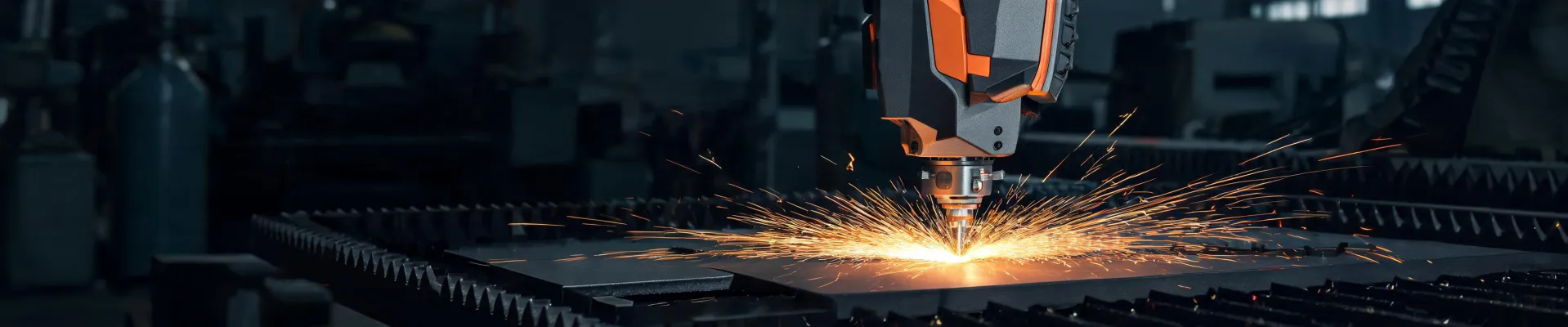
I Saved $15,000 on a Laser Cutter and It Cost Me Twice That
Posted on 2026-08-17 by Elise Marceau
In December 2021, I stood at our loading dock feeling like I'd pulled off something clever. The truck backed in carrying what my boss and I called the 'budget capability expansion.' The total was $18,500. The fiber laser system I'd originally wanted was quoted at $33,500. For a twelve-person fabrication shop outside Toledo, the $15,000 difference felt enormous. In my head, saving that money was the right business call.
The sales rep made the route sound straightforward. 'You've already got the CNC table,' he said. 'Bolt on this plasma cutter adapter and you've got edge-cutting. Add the used CO₂ laser for thin sheet and engraving. Same work, half the cost.'
I knew I should've run trial parts on our actual materials before signing. I knew I should've compared consumable costs and service response times. But we were behind on orders, and I talked myself past the verification step. What are the odds it wouldn't work? Well—the odds caught up with me.
How I Talked Myself Into a Bargain
To be fair, the decision wasn't crazy. We needed more cutting capacity, and the owner wasn't convinced we could justify the cost of a new fiber laser cutting machine. He told me to find a way to stretch the budget. The plasma cutter adapter fit our existing table, and the used CO₂ laser came from a shop that was moving up to—ironically—fiber. The numbers fit. The budget fit. The plan looked sound.
The problem is that 'looks sound' and 'is sound' are two different things. I want to say the first problems surfaced within two weeks. Honestly, it was by day four. The plasma cutter adapter on 14-gauge cold rolled steel produced dross that took longer to grind off than the cut saved. My guys nicknamed it 'the grinder's friend.' By week three, the height control was drifting, and we were stopping runs to reset the torch. Then the CO₂ laser started acting up.
No wait—the mirror cleaning started acting up first. That became a twice-a-week ritual. And the lens replacement cost, which I hadn't put in any budget, hit in month one. I should add that we went through assist gas a lot faster than the rep had implied. The machine ran, but it ran like a leaky bucket.
The First Cracks
None of those issues alone was catastrophic. Together, they drained the efficiency we'd promised ourselves. Aluminum became a nightmare. The CO₂ beam reflected unpredictably off the surface, and the operators were genuinely uncomfortable running it. We learned more about beam alignment in January 2022 than I ever wanted to know. When the machine worked, it was fine. But the 'fine' days never matched the promised uptime.
I remember one morning, after a two-day wait for a replacement mirror, I stood in the shop and thought: we spent $18,500 to become a part-time metal processor when we used to send this work out and get it back on time. That thought should've been a wake-up call. I didn't let it sink in.
The Job That Exposed Everything
In February 2022, our biggest client, a manufacturer of control cabinets, added a nameplate job to our contract: 120 stainless steel nameplates with a laser-marked logo and a safety color stripe. Their brand spec cited the Pantone Matching System and required a color tolerance under Delta E < 2 for the mark. Industry standard is Delta E < 2 for brand-critical colors; 2 to 4 is noticeable to a trained observer, and anything above 4 is visible to most people. (Reference: Pantone Color Matching System guidelines.)
The detail spec was equally unforgiving. The logo artwork had to hold what the client called print-resolution quality—equivalent to 300 DPI at final size—so the edge of each character had to stay crisp under magnification. Our engraving couldn't hold that consistency across 120 pieces. By the fortieth nameplate, the color mark was visibly drifting, and the character edges looked ragged. Depth varied from piece to piece. The client rejected the entire batch.
$3,200 worth of stainless went into the scrap bin. The money hurt. The credibility hit hurt worse. The client didn't cancel the contract, but they asked whether we actually had the right machine for the job. I didn't have a good answer.
The Spreadsheet That Hurt
In March 2022, I sat down and counted what the 'bargain' really cost over the first four months:
- roughly $3,100 in CO₂ consumables (lenses, mirrors, assist gas)
- roughly $2,200 in labor regrinding plasma-cut edges
- $3,200 for the rejected nameplate batch
- $1,800 for downtime waiting on replacement parts
That's about $10,300 on top of the $18,500 purchase price—and we still didn't have a process we could bill with confidence. I ran the comparison again with the fiber laser system we'd passed on. Its price was higher, sure. But its operating costs were far lower: no beam-path mirrors, lower electricity consumption, and it cuts stainless and aluminum without the reflection drama. I recalculated the decision as a total-cost-of-ownership problem over 24 months. The verdict: the fiber option would have paid back its higher price within about 14 months through rework savings and uptime alone.
The surprise wasn't that budget equipment had problems. I'd expected that. The surprise was how fast the hidden costs stacked up and made the 'expensive' option the cheap one. The unit price on the quote was the smallest number in the whole equation.
Doing It Right the Second Time
After that reckoning, I rewrote how our shop evaluates equipment. I turned the lesson into a checklist that's still on the wall today:
- Run trial parts on your actual material, not the vendor's glossy demo coupons.
- Compute the 24-month TCO, including consumables, maintenance, and expected rework.
- Get the service commitment in writing and test the support line before you buy.
- Ask for references from shops with a production profile similar to yours.
- Match the process to the job: fiber for metal, CO₂ for non-metals, plasma for heavy plate.
In September 2022, we bought a bodor fiber laser cutting machine. I'll be straight with you: it wasn't the lowest quote we received. But the trial parts on our exact materials came back clean, the consumable cost estimate was lower, and the bodor team actually picked up the phone when I called during the evaluation. That matters more than most people realize.
The machine changed how we operate. We now run fiber laser engraving on stainless and aluminum with a level of depth control and contrast that the old CO₂ couldn't get near. Our edge quality on sheet metal eliminated the regrinding step entirely. And because the machine is faster on our typical parts, the production time we got back felt like hiring a second shift.
We added a bodor laser welder after a client asked for repeatable, clean welds on a 500-unit fixture order in March 2023. That single contract covered a solid chunk of the welder's price. Then we took on a bodor tube laser for a railing and tubular furniture line, which became roughly 18% of our revenue in year one. I don't know if that percentage will hold long-term, so take it with a grain of salt. But the pattern is clear: buy for total cost, not sticker price.
The Takeaway
I've made peace with the mistake. The rejected batch, the $10,300 in hidden costs, the lost credibility—call it tuition. I'm writing this because someone else is probably standing where I stood in December 2021, staring at a quote that's $15,000 cheaper and convincing themselves the specs don't matter.
Maybe you're evaluating a bodor or a competitor, or a plasma cutter adapter for your existing table. Run the TCO before you sign. Ask about consumables, filters, lenses, service response, and how the machine handles your parts—not the demo coupon. And if a sales rep says 'it's basically the same thing for less money,' ask them to put that in writing, with a tolerance.
And for anyone who found this post searching 'laser co2 fracionado antes e depois'—that's a cosmetic treatment term, not an industrial one. The before-and-after I offer is a total cost spreadsheet that went from red to black. That's the only transformation I can promise.
The cheapest machine in the world isn't cheap if it fails the job you bought it for.

Elise Marceau
Elise Marceau is an LED display and digital-signage systems analyst covering LED video walls, modular screens, transparent LED, control processors, and indoor or outdoor signage. She applies IEC 62368-1 safety principles while comparing pixel pitch, luminance, contrast, refresh rate, colour uniformity, viewing angle, ingress protection, power density, module serviceability, and signal redundancy. Her specification guides help integrators, venue operators, retailers, and procurement teams align viewing distance, ambient light, content format, installation access, electrical load, and lifecycle support.